Simple sauces are the quickest way to make ordinary ingredients taste finished, and core techniques are what make those sauces reliable. Once you understand a few building blocks, weekday cooking becomes less about slavishly following recipes and more about making sensible decisions with whatever you’ve just grabbed from the fridge or cupboard. In a typical British kitchen — where the weekly shop might be a mix of reduced-price veg from Tesco, a bag of own-brand pasta, and a half-forgotten punnet of mushrooms — knowing how to pull a meal together with a good sauce changes everything. It’s the difference between staring at a pack of chicken thighs and actually looking forward to dinner.
Why sauces and basic techniques matter
Most home cooking problems aren’t really recipe problems. They’re timing, texture, and flavour problems. A well-made sauce can rescue dry chicken, bland pasta, tired vegetables, or a pan of leftovers that desperately needs a second life. Core techniques help you avoid waste, cook more confidently, and get far better results from supermarket staples — even the budget ones.
For UK home cooks, this matters even more because shopping tends to be a mix of seasonal produce, own-brand basics, and whatever is yellow-stickered at the end of the day. If you can turn those slightly limp leeks and that lonely tin of chopped tomatoes into a meal that feels complete, you cook more cheaply and with much less stress. I’ve lost count of the number of times a forgotten bag of spinach and the last spoonful of crème fraîche have become a midweek sauce that made supper feel almost deliberate.
The 3 levels of everyday cooking skill
Think of this as a natural progression. You don’t need to master everything at once — just start where you are and build from there.
| Level | What you can do | What becomes important |
|---|---|---|
| 1. Starting out | Make a few basic sauces and follow simple pan instructions | Heat control, seasoning, not overcooking |
| 2. Building confidence | Combine techniques and adjust flavour to taste | Texture, balance, timing, saving a sauce if it splits or tastes flat |
| 3. Cooking freely | Cook from what is available rather than from a strict recipe | Ingredient substitution, planning ahead, scaling up for batch cooking |
If you’re still relying on packet mixes or jars of ready-made sauce for every meal, start at Level 1. There’s no shame in that — most of us began there. If you already cook a few times a week but want better flavour and fewer wasted ingredients, Level 2 is where the biggest gains usually happen. That’s when you stop panicking if a white sauce goes lumpy and start knowing exactly how to fix it with a quick whisk and a splash of warm milk.
The essential techniques every home cook should know
1. Sautéing
Sautéing means cooking food quickly in a small amount of fat over medium to medium-high heat. It’s the starting point for many sauces, soups, and traybake-style meals. Get this right, and you instantly build layers of flavour.
Use it for:
- onions, garlic, leeks, celery
- mushrooms, courgettes, peppers
- minced meat, chicken pieces, tofu
Practical tips:
- Let the pan heat properly before adding ingredients — a cold pan steams things.
- Don’t overcrowd the pan, or the food will steam instead of brown. If you’re cooking for four, do it in batches.
- Stir often, but not constantly. A little stillness builds colour.
Typical mistake: adding garlic too early and burning it before the rest of the dish is ready. Garlic needs only 30–60 seconds in a hot pan before it turns bitter. Add it after your onions have softened, not at the same time.
For a quick weeknight win, try sautéing sliced leeks and mushrooms in a knob of butter, then stir through a spoonful of wholegrain mustard and a splash of single cream. That alone can sit proudly next to sausages or a piece of fried cod.
2. Simmering
Simmering is gentle cooking just below a boil. The surface should show small, lazy bubbles, not a rolling frenzy. Think of a pot of lentil soup on a back burner, quietly getting on with things while you sort the rest of dinner.
Use it for:
- tomato sauces
- soups and stews
- gravy-style reductions
- beans, lentils, and some grains
Why it matters: a hard boil can make sauces split, toughen meat, or reduce liquids too quickly — leaving you with something that’s both burnt and watery at the same time. If you’re making a milk-based sauce, a rolling boil will almost certainly curdle it, so keep that heat low and watch for the first gentle plop.
If you’ve ever made a tomato sauce that tasted harsh and tinny, chances are it didn’t simmer long enough. Give it at least 20 minutes, and the flavour will soften and round out beautifully.
3. Thickening
A sauce often needs body, not just liquid. There are several easy ways to thicken one, and each suits a different kind of dish.
Common methods:
- Reducing: simmer until the liquid concentrates. This intensifies flavour and thickens naturally.
- Starch slurry: mix cornflour with cold water, then add it gradually to the hot sauce. Great for gravies and stir-fry sauces.
- Roux: cook equal amounts of plain flour and butter together before adding liquid. This is the classic base for white sauce and cheese sauce.
- Blending: purée some of the vegetables or beans in the dish to add natural thickness. A stick blender can turn a chunky soup into something velvety without adding anything extra.
Choose the method that suits the dish. A tomato sauce may only need reduction. A white sauce nearly always starts with a roux. A vegetable soup can be thickened by blending a portion of it, saving you from opening a packet of anything. And if you’re leftover-roast-chicken on a Tuesday, the pan juices, a spoonful of flour, and some stock will give you a proper gravy in minutes.
4. Deglazing
Deglazing means adding liquid to a hot pan to lift the browned bits stuck to the base. Those caramelised bits hold an enormous amount of flavour — they’re the reason restaurant pan sauces taste so good.
Use:
- stock
- water (yes, even water works if you’ve built enough flavour)
- wine — a splash of dry white or red, whatever is open
- a splash of vinegar or lemon juice, depending on the dish
This is especially useful after frying chicken, mince, mushrooms, or onions. It turns the leftover pan residue into the base of a proper sauce. After cooking sausages for bangers and mash, I’ll often deglaze with a little chicken stock, let it bubble for a minute, then stir in a teaspoon of redcurrant jelly and a knob of butter. It feels like a Sunday dinner trick on a Wednesday.
Don’t be shy — scrape the pan with a wooden spoon while the liquid bubbles, and you’ll lift every last bit of flavour.
5. Seasoning in layers
Seasoning is absolutely not just salting at the end. Good flavour is built in stages, and learning to taste as you go is what separates a flat dish from a lively one.
A simple approach:
- season ingredients lightly before cooking — a pinch of salt on your onions as they sweat draws out moisture and helps them soften
- taste during cooking; dip a clean spoon in and check
- adjust near the end with salt, acid, herbs, or a small amount of sweetness
This is where many home cooks go wrong. They add salt once, at the table, and wonder why the dish still tastes dull. Often it needs acid — a squeeze of lemon or a dash of cider vinegar — not more salt. If your tomato sauce tastes flat despite plenty of seasoning, try half a teaspoon of balsamic vinegar and watch it come alive.
The 5 simple sauces worth learning first
These are practical, flexible, and genuinely useful in an ordinary UK kitchen. None require fancy ingredients, and each one can be adapted depending on what’s in the fridge.
| Sauce | What it is | Best with | Main risk |
|---|---|---|---|
| Tomato sauce | Tomatoes cooked with aromatics and seasoning | pasta, eggs, beans, fish, chicken | too sharp or too thin |
| White sauce | Milk thickened with a roux | cauliflower cheese, fish pie, pasta bakes | lumps or floury taste |
| Pan sauce | Liquid added to the cooking pan and reduced | meat, mushrooms, roasted vegetables | too salty or too thin |
| Mustard cream sauce | Cream or crème fraîche with mustard | chicken, sausages, leeks | curdling if overheated |
| Herb oil or vinaigrette | Oil plus herbs, acid, and seasoning | salads, roast veg, grains | too much acid or no balance |
1. Everyday tomato sauce
A good tomato sauce is the backbone of cheap, flexible cooking. I make at least one batch a week, often doubling it and freezing half in an old yogurt tub for another day.
Basic method:
- sauté a finely chopped onion and a clove of garlic in olive oil until soft but not coloured
- add a tablespoon of tomato purée and cook for a minute to take away the raw taste
- tip in a 400g tin of chopped tomatoes, a pinch of sugar if they’re especially sharp, and season with salt and pepper
- simmer for at least 20–25 minutes, until it’s thickened and glossy
- finish with a handful of fresh herbs (basil or parsley) or a knob of butter for richness
Use it with pasta, baked eggs, mince, chickpeas, or roasted vegetables. If you want to turn it into a quick arrabbiata, add a pinch of chilli flakes with the garlic. For a more substantial sauce, stir in a drained tin of lentils or some leftover cooked chicken ten minutes before the end.
Common mistake: stopping too soon. A raw tomato sauce often tastes thin and sour. It needs time to lose that tinny edge and develop depth. If you’re in a rush, add a splash of milk or a tiny pinch of bicarbonate of soda to neutralise some acidity — a trick my nan swore by.
2. White sauce
White sauce (béchamel, to give it its proper name) is endlessly useful because it turns simple ingredients into something cohesive. Once you can make one without lumps, cauliflower cheese and fish pie stop feeling like weekend projects.
Basic method:
- melt 25g butter in a heavy-based saucepan over a medium heat
- stir in 25g plain flour and cook for 1–2 minutes, until it smells biscuity but hasn’t browned
- slowly whisk in 300ml warm milk, a splash at a time at first, then in a steady stream
- simmer gently until smooth and thickened, usually 5–7 minutes
- season with salt, pepper, and a little mustard powder or grated nutmeg if you like
Use it for macaroni cheese, fish pie, cauliflower cheese, and vegetable bakes. If you want a cheesier version, stir in a handful of grated extra mature cheddar once the sauce is off the heat.
Common mistake: pouring in cold milk too fast, which causes lumps. Warming the milk first and adding it gradually while whisking constantly makes all the difference. If you do get lumps, don’t panic — a quick blitz with a hand blender will rescue it in seconds.
3. Quick pan sauce
This is the simplest “restaurant-style” upgrade for home cooking, and it takes exactly the time your meat needs to rest.
Basic method:
- cook your meat or vegetables, then transfer them to a plate to rest
- lower the heat slightly under the same pan, leaving all the sticky browned bits
- add a splash of stock, wine, or even plain water — about 100–150ml is plenty
- scrape the base with a wooden spoon to deglaze, then let it bubble and reduce by about half
- once it’s syrupy, stir in a knob of butter, a spoonful of cream, or a teaspoon of mustard
This works particularly well with sausages, chicken thighs, pork chops, or mushrooms. If you’ve roasted a chicken, transfer the roasting tin to the hob, add a glass of white wine and a little stock, and scrape up every bit of flavour — you’ll never go back to granules.
4. Mustard cream sauce
This is a proper midweek lifesaver because it feels far richer than it actually is, and it takes less than five minutes. Perfect for those evenings when you need something that tastes a bit special without any effort.
Basic method:
- gently warm 150g crème fraîche or a mixture of double cream and a splash of milk in a small pan
- stir in a heaped teaspoon of wholegrain mustard (or Dijon for a smoother sauce)
- season with salt and a tiny pinch of pepper
- taste, then add a squeeze of lemon juice or a drop of cider vinegar if it needs brightening
- do not let it boil, or it may split
Use it with leeks, chicken, salmon, sausages, or roasted potatoes. If you’ve got leftover leeks from a Sunday roast, slice them, sauté in butter, and pour this sauce over — it’s a side dish that can almost carry the whole meal. For a cheaper version, half-fat crème fraîche works beautifully, and it’s less likely to split than single cream.
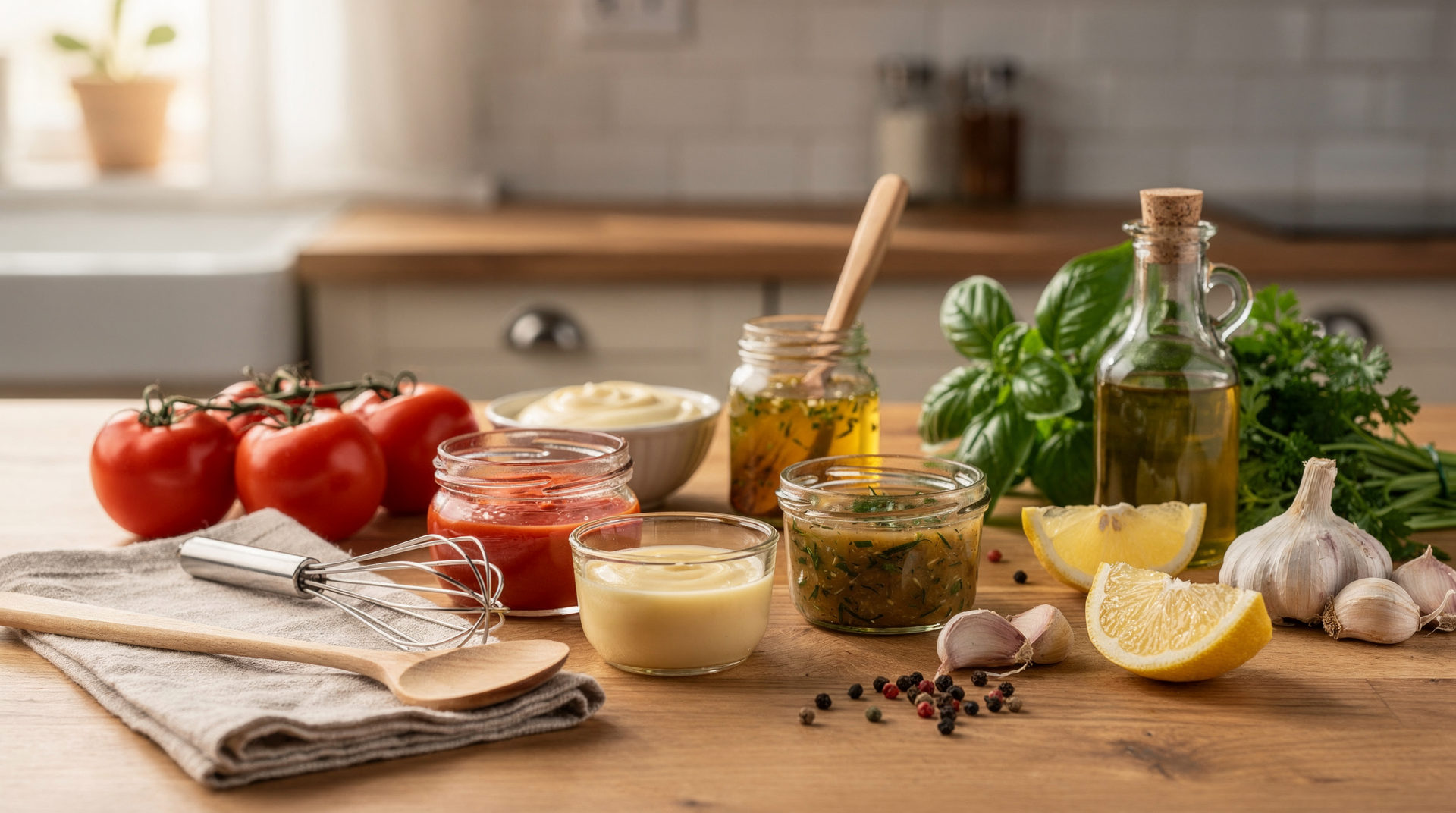
5. Vinaigrette and herb dressing
Not every sauce needs cooking. A good dressing can save a boring salad or make cold leftovers feel intentional — and you can shake one up while the rest of dinner is on the hob.
Basic method:
- 3 parts oil to 1 part acid is a useful starting point (e.g., 3 tablespoons olive oil to 1 tablespoon cider vinegar or lemon juice)
- add a teaspoon of Dijon mustard, a pinch of salt, pepper, and any fresh or dried herbs you have
- shake in a jam jar or whisk until emulsified
Use it with new potatoes, roast vegetables, chickpeas, couscous, or a cold chicken salad. If you’re using yesterday’s roast veg, a good vinaigrette can make them taste like a lunch you’d actually choose, not just fridge grazing. A squeeze of honey or a pinch of sugar softens the acidity beautifully. And if you’ve run out of fresh herbs, a teaspoon of dried oregano or mint will still do the job.
How to build flavour without making cooking complicated
If your food tastes flat, it almost always needs one of four things:
- Salt to sharpen the overall flavour
- Acid such as lemon juice, vinegar, or yogurt to brighten
- Fat to carry flavour and give richness
- Heat from chilli, mustard, pepper, or gentle spices
A useful check while you cook is to ask yourself: What is missing? If a sauce tastes heavy and claggy, add acid. If it tastes thin and watery, reduce it or add a knob of butter. If it tastes harsh and sharp, a little fat or a pinch of sugar will soften it. If it tastes dull, it may just need another pinch of salt — and be careful not to overdo it.
This isn’t about turning every meal into a restaurant dish. It’s about trusting your palate and making small adjustments until the food tastes balanced and satisfying. When I make a quick lentil stew and it’s a bit meh, a splash of malt vinegar and a drizzle of olive oil at the very end often sorts it out.
Step-by-step: turn one pan into dinner
Use this structure when you don’t want to follow a detailed recipe and just need to get something on the table. It’s the foundation of so much practical British cooking.
A simple weekday formula
- Start with an aromatic base: onion, garlic, leek, celery, or shallot. Sweat it gently in a little oil or butter.
- Add the main ingredient: chicken thighs, minced beef, a tin of beans, sliced mushrooms, white fish fillets, or whatever vegetables you have.
- Build the sauce: pour in stock, chopped tomatoes, milk, cream, mustard, or just the pan juices with a splash of water.
- Simmer until the main ingredient is cooked through and the sauce has reached the right consistency — usually anywhere from 10 to 30 minutes, depending on what you’re making.
- Finish with seasoning, herbs, acid, or a pat of butter to pull everything together.
This approach works brilliantly for British staples such as sausages and mash (with a quick onion gravy), chicken thighs with creamy mushrooms, pasta with a simple sausage ragu, a lentil bolognese-style sauce, or a fish pie filling made straight in the pan. Once you internalise the flow, you’ll find yourself cooking without a recipe more often than not — and it feels wonderfully freeing.
Common mistakes and how to fix them
| Problem | Likely cause | Fix |
|---|---|---|
| Sauce tastes bland | Under-seasoned or under-reduced | Add salt carefully, then simmer longer to concentrate flavour |
| Sauce tastes too sharp | Tomatoes or vinegar not balanced | Add a little butter, a pinch of sugar, or a spoonful of cream |
| Sauce is lumpy | Flour or milk added too fast | Whisk hard, or strain/blend with a hand blender if needed |
| Sauce split or looks oily | Heat too high, especially with cream | Lower the heat and whisk in a spoonful of cold water or cream |
| Food tastes dry | Overcooked protein or no finishing sauce | Add a pan sauce, dressing, or a quick gravy-style reduction |
Remember, almost every mistake is fixable — especially if you catch it before the food hits the plate. A split cream sauce looks worse than it tastes, and a quick whisk with a splash of cold milk often brings it back. The only real disaster is giving up and ordering a takeaway when dinner was salvageable all along.
A practical learning path for home cooks
If you want to improve quickly, learn in this order. I suggest this exact path to friends who feel stuck in the cycle of recipe books and takeaway menus.
- Make a basic tomato sauce and really taste it throughout cooking.
- Learn to sauté onions, garlic, and mushrooms properly — paying attention to heat and timing.
- Make a simple white sauce without lumps; once you’ve cracked it, you’ll laugh at how easy it is.
- Practise a pan sauce after cooking chicken or sausages — it adds maximum flavour for minimum effort.
- Learn one cold dressing you can use on roast veg and salads, then vary the herbs and acid to suit the meal.
- Start adjusting flavour with salt, acid, and fat instead of only following recipes. Taste, tweak, trust yourself.
That order gives you the most useful return for the least effort. You’ll be amazed how quickly you go from “what’s for dinner?” to “what can I make with the odds and ends in the fridge?”
Tools that make these techniques easier
You do not need a professional kitchen. A few basics are enough, and in a compact UK kitchen, choosing things that earn their keep is essential.
- a sturdy frying pan or sauté pan — ideally one that can go from hob to oven
- a saucepan with a heavy base for even heating
- a whisk (a simple balloon whisk is perfect)
- a wooden spoon or silicone spatula for deglazing and stirring
- a small jug for pouring milk or stock without splashing
- a fine grater for cheese, nutmeg, and garlic — much easier than a press
In a small kitchen, storage matters as much as equipment. If you only have space for one frying pan, make it a decent non-stick that can handle eggs, sautéing, and quick pan sauces. I’ve cooked entire meals in a deep sauté pan that doubled as a serving dish when I was too tired to wash up extra plates.
Checklist: can you already do the basics?
Use this to judge your current level honestly — not to beat yourself up, but to see where to focus next.
- I can sauté onions without burning them.
- I know the difference between a simmer and a boil.
- I can thicken a sauce using reduction or a roux.
- I can taste a sauce and tell whether it needs salt, acid, or fat.
- I can make at least one sauce from memory, without glancing at a recipe.
- I can rescue a pan of food with a quick sauce.
- I can adapt a recipe using what is already in the fridge.
If most of these are still difficult, don’t worry — focus on the first three techniques until they feel second nature. Everything else cascades from there.
FAQ
What is the easiest sauce for beginners?
A simple tomato sauce is usually the easiest because it is forgiving, inexpensive, and useful with many meals. Even if you over-reduce it, you can add a splash of water and carry on. The ingredients — tinned tomatoes, an onion, garlic, and oil — are almost always in the cupboard, and it keeps well in the fridge for up to four days.
What is the difference between simmering and boiling?
Simmering uses gentle heat with small bubbles just breaking the surface. It cooks food evenly and allows flavours to meld. Boiling is much more vigorous and can damage texture, toughen meat, or reduce sauces too quickly. If a recipe says “bring to the boil then reduce to a simmer,” it means get it bubbling once, then turn the heat down low.
How do I stop white sauce from going lumpy?
Cook the flour and butter together first (the roux) for a minute or two to eliminate any floury taste. Then add warm milk gradually while whisking constantly. If you pour in cold milk too fast, lumps are almost guaranteed. Keep a hand blender nearby as a safety net, but with practice you won’t need it.
Can I make good sauces without stock cubes or shop-bought jars?
Absolutely. Onion, garlic, pan juices, tomatoes, milk, herbs, mustard, and a bit of lemon or vinegar can build a lot of flavour on their own. Fried mushrooms give a deep, savoury note, and even the water from cooking vegetables can be used as a light stock. Once you start cooking this way, you’ll find you buy fewer processed sauces without missing them.
What should I learn next after simple sauces?
Learn how to roast vegetables well, cook grains and lentils properly, and use leftovers in a way that keeps flavour and texture intact. A tray of roasted veg with a good dressing and a handful of cooked pearl barley is a complete meal, and it costs pennies.
Simple sauces and core techniques are not just cooking basics; they are what make everyday food more flexible, less wasteful, and more satisfying. Once you can sauté, simmer, thicken, and season with confidence, you can turn a small set of British supermarket ingredients into meals that feel deliberate rather than improvised. That half-pack of mushrooms, the last leek, the tub of crème fraîche approaching its use-by date — they’re all the start of something good. And on a rainy Tuesday when you’re staring into the fridge, that’s just the kind of reassurance you need.