A small kitchen can still feel like the heart of your home—calm, efficient, and actually pleasant to cook in—if you set it up around the way you really live. In my London flat, I’ve had to learn this the hard way, wrestling with worktops the size of a tea towel and cupboards that seem to swallow things whole. What works here isn’t about glossy show-home perfection; it’s about making a compact kitchen easier to use, quicker to clean, and a lot less frustrating when you’re rushing to get a weeknight meal on the table.
Start with the real constraints of your kitchen
Before you buy any organisers or start reshuffling cupboards, take a hard look at what you’re actually working with. Most small UK kitchens share a familiar set of headaches: lack of cupboard space, precious little worktop area, appliances that got plonked in the only spot available, and in open-plan flats or studio layouts, the blur between cooking and living space.
Identify your main pressure points
Stand in your kitchen at the time you usually cook and ask yourself a few honest questions:
- Where does clutter pile up first?
- What do I reach for every single day?
- Which items are always in the wrong place when I need them?
- What makes cooking feel cramped, slow, or just a bit of a faff?
The answer almost always reveals the real bottleneck far better than any storage trend or magazine spread. A kitchen doesn’t need to look spacious to work well; it simply needs to support your routine without making you walk miles for a wooden spoon.
Common small-kitchen types in the UK
| Kitchen type | Typical issue | Best first fix |
|---|---|---|
| Galley kitchen | Narrow walkway, limited passing space | Keep counters clear and store by zone |
| Compact L-shaped kitchen | Corner dead space, uneven access | Use corner storage and vertical space |
| Studio or open-plan kitchenette | No separation between cooking and living | Reduce visual clutter and use covered storage |
| Older terrace or flat kitchen | Odd cupboards, shallow shelves | Add shelf risers and flexible containers |
Build the kitchen around three zones
Even the tiniest kitchen starts to make sense when every item has a clear job and a clear place. The simplest way to organise it is by thinking in terms of three distinct zones: cooking, prep, and cleaning. They don’t need physical walls—just a logical grouping that matches how you move.
1. Cooking zone
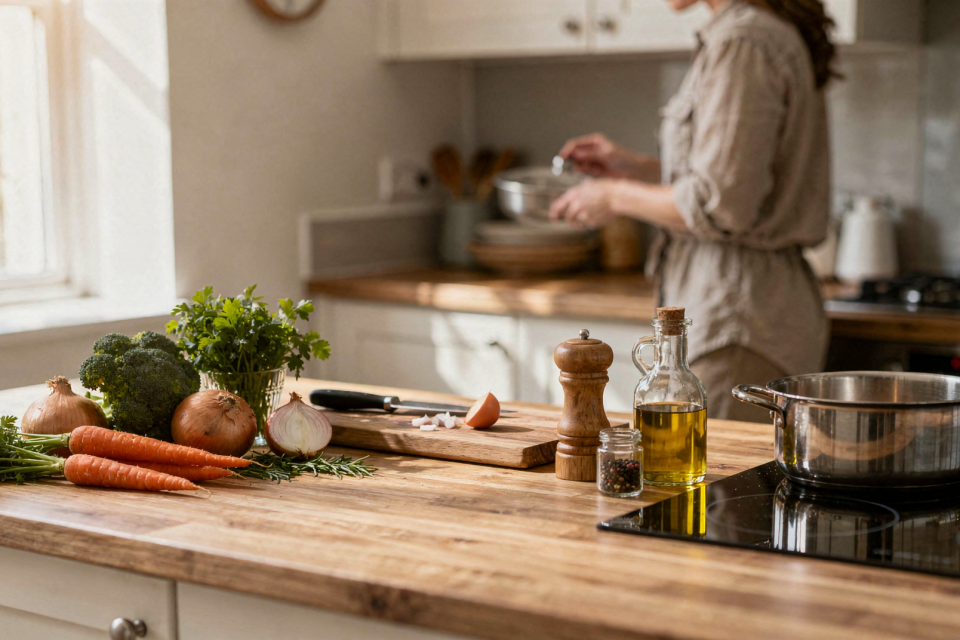
This is the area right around the hob and oven. Store here the things you grab mid-cook when you can’t afford to rummage: pans, spatulas, oven gloves, oil, salt and pepper, and the everyday spices that actually get used (for me, it’s smoked paprika, cumin, and a decent black pepper grinder). If you have to weave across the kitchen for a pinch of salt or a fish slice, the layout is working against you. Make this zone the easiest one to reach when you’re already standing over a sizzling pan.
2. Prep zone
This is your main worktop stretch, even if it’s no bigger than a chopping board. Keep here the tools that support the bulk of your prep: chopping boards, your sharp chef’s knife, mixing bowls, measuring spoons, food containers, and the ingredients you use most frequently—think garlic, onions, olive oil. If your prep area is tiny, defend it ferociously. In a small kitchen, one completely clear section of worktop is worth far more than a fully styled counter cluttered with gadgets.
3. Cleaning zone
Keep washing-up essentials together near the sink: washing-up liquid, cloths, scrubbers, bin liners, and recycling basics. This stops cleaning supplies from colonising every surface and makes tidying up after a meal feel less like a chore. I keep mine in a simple caddy under the sink—it’s nothing fancy, but it means I can clean up in one sweep instead of hunting for the sponge that’s migrated behind the kettle.
Choose storage that fits the space you actually have
Good small-kitchen storage isn’t about buying a mountain of matching containers. It’s about using the space you already have in a way that makes daily cooking flow. Most of us underestimate the potential above our heads and inside cupboard doors.
Use vertical space first
In so many older UK flats and terraced houses, the room above shelves and inside cupboard doors goes completely unused. Fix that before you even think about adding more furniture. Shelf risers double the usable height in a cupboard. Over-the-door hooks hold lids, tea towels, or even lightweight pans. Wall-mounted rails or magnetic knife strips free up drawers and keep knives safe and close. Stacking organisers and slim baskets tame those awkward tall cupboards where things disappear into the abyss. Vertical storage is a lifesaver when cupboard depth is a bit silly—a problem I know all too well from London rentals.
Make cupboards work harder
Inside your cupboards, the real enemy is hidden dead space. That deep corner where tins go to expire, or the top shelf you can barely see. Improve it with adjustable shelf inserts so you’re not wasting inches, stackable storage boxes that let you pull out a whole category at once, pull-out trays if you can fit them, plate dividers, and simple labelled bins that group similar items—baking supplies, tinned goods, snacks. If you can’t see an ingredient easily, you’ll forget it exists. That’s when duplicates start creeping in and food waste quietly builds up.
Keep only what you use
A small kitchen can’t afford to carry emotional baggage in the form of equipment you use once a year. I’ve got one rule that works remarkably well:
- Daily use: keep within arm’s reach, front and centre.
- Weekly use: keep accessible but not hogging prime real estate.
- Rare use: store high up, low down, or honestly, elsewhere—under the bed, in a hallway cupboard, or passed on to a friend.
If that fancy spiralizer or festive trifle dish only sees daylight in December, it’s probably costing you valuable everyday space.
Pick compact equipment that earns its place
In a small home, every appliance and tool needs to justify the footprint it occupies. Bigger isn’t better if it chokes your workflow.
Essential equipment for most small UK kitchens
| Item | Why it matters | What to look for |
|---|---|---|
| Frying pan | Everyday workhorse for eggs, stir-fries, pancakes, searing | One medium non-stick or stainless-steel pan that goes from hob to oven if possible |
| Saucepan set | For pasta, grains, soups, vegetables, boiling the kettle backup | Stackable sizes with lids that fit snugly; a set of two is often enough |
| Sharp chef’s knife | Speeds up prep and is actually safer than a blunt drawer full of knives | One reliable knife you keep sharp; I’d spend my budget here and scrimp elsewhere |
| Chopping board | Protects surfaces and supports all your prep | Thin but sturdy board that stores upright; having two means you can switch between raw meat and veg without washing between every chop |
| Mixing bowl | Useful for cooking, serving, and even storing leftovers | Nesting bowls save heaps of space; a set of three covers most jobs |
| Baking tray | For roasting veg, toasting bread, reheating, and the occasional traybake | A standard-size tray that actually fits your oven; measure before you buy |
| Food storage containers | Reduces waste and makes batch cooking for the week genuinely possible | Uniform shapes that stack neatly; glass or sturdy plastic with matching lids so you never hunt for the right lid again |
Be selective with appliances
In a cosy UK kitchen, these are the usual culprits hogging precious countertop: air fryer, stand mixer, microwave, toaster, kettle, coffee machine. You don’t need to banish every single one, but do ask whether each genuinely saves you time and effort or simply adds clutter. For example, if you only bake sporadically, a hand mixer lives far more compactly than a stand mixer and does most of the same jobs. If your oven is reliable and you’re not cooking for a crowd, a separate microwave might not earn its keep. Choose the appliances that work for your real life, not an aspirational Sunday bake-off.
Design for daily cooking, not occasional perfection
A kitchen setup should support Tuesday night’s hurried spaghetti bolognese as comfortably as a relaxed weekend roast. The best small kitchens make everyday cooking feel straightforward and even a little bit joyful.
Keep everyday ingredients visible
Use clear, consistent containers or open shelving for the staples you reach for multiple times a week: oats, pasta, rice, flour, stock cubes, tea and coffee, tinned tomatoes, and cooking oil. Being able to glance and see exactly what you have prevents those irritating moments of buying yet another bag of basmati when there were already two lurking at the back of the cupboard. It also means ingredients don’t get forgotten in opaque tins that blend into the background.
Store by meal pattern
This trick has been a game-changer in my kitchen. Most UK households cycle through a familiar set of repeat meals—porridge or toast in the morning, a quick lunch of soup or beans on toast, pasta dishes, stir-fries, or jacket potatoes. Organise your cupboards so that breakfast items sit together, quick lunch bits are in one spot, pasta and sauce ingredients live side by side, and baking basics are grouped. When you come to make dinner, you’re not opening three separate cupboards just to find the pasta, the tin of tomatoes, and the dried herbs.
Make the “last 10 minutes” easier
So much kitchen frustration piles up in that final stretch: draining, serving, packing away leftovers, and wiping down. Set up your space to carry you through that stage smoothly. Keep a colander close to the sink, serving spoons in a jar near the hob, containers and reusable wraps ready for leftovers, tea towels within easy reach, and at least a corner of the dish rack or draining board clear. If the end of cooking feels calm rather than chaotic, the whole kitchen seems twice as manageable.
Handle food storage properly
A small kitchen often fails not because of square footage but because the food storage system is inconsistent—leading to waste, confusion, and overbuying. A little discipline here pays off in lower supermarket bills and less frantic Tesco dashes.
Use a simple rotation system
FIFO—first in, first out—sounds like a canteen rule, but it works wonders at home. Put older food at the front and newer food behind it. Apply this to tins, jars, sauces, cheese, leftovers, and especially those bagged salads and fresh herbs that turn sad so quickly. If you do a regular Sainsbury’s or Lidl shop, this simple habit stops forgotten items from mouldering at the back of the fridge.
Make the fridge easier to read
A cluttered fridge wastes food because people stop noticing what’s buried in there. Keep it organised by broad categories: dairy together, cooked leftovers in a clear container, raw meat or fish on the bottom shelf where it’s safest, vegetables in the crisper, and condiments in the door. Don’t overload shelves—cold air needs room to circulate, and a jam-packed fridge is a nightmare to navigate. I try to have a quick “fridge sweep” on a Sunday evening before the week begins, just so nothing gets lost.
Use freezer space strategically
Even a modest drawer freezer above the fridge can be a powerful ally if you treat it as a buffer for busy weeks, not a dumping ground for forgotten bargains. Good freezer habits turn it into a practical resource: freeze bread in portions, pour leftover soup or curry into flat freezer bags (labelled with the date!), flattening them to save space and speed up reheating. Group similar items together—frozen veg in one section, batch-cooked meals in another. If you batch cook during the week, as so many of us do when the working day ends late, freezer organisation often counts for more than fridge size.
Small-kitchen organisation mistakes to avoid
Some common habits can make even a reasonably compact kitchen feel like a broom cupboard. I’ve been guilty of most of these at one point or another.
The biggest mistakes
- Keeping rarely used gadgets on the worktop because “they might be handy”
- Buying storage products before you’ve had a good declutter
- Using mismatched containers that refuse to stack neatly
- Filling every cupboard shelf all the way to the back—obscuring what’s there
- Storing everyday essentials in inconvenient places (why is the oil on a high shelf?)
- Ignoring the natural workflow between sink, hob, and prep area
The problem isn’t usually a lack of space. It’s space being used without a clear plan.
A good test
If you can make a cup of tea, cook a simple dinner like sausage and mash or a quick stir-fry, and clean up afterwards without constantly moving things out of the way, your kitchen is probably set up well enough. If every task requires detours and reshuffling, the layout needs a bit of attention. That’s your signal to revisit the zones.
Step-by-step: set up a small kitchen in one afternoon
If you want a practical reset that won’t eat your weekend, work through it in this order:
- Empty one cupboard or zone at a time—don’t try to do the whole kitchen at once or you’ll be eating cereal on the sofa in a sea of pans.
- Group items into keep, relocate, and remove. Be ruthless but realistic.
- Move daily-use items to the easiest-to-reach shelves and drawers.
- Put pans, utensils, and ingredients into clear zones based on cooking, prep, and cleaning.
- Add only the storage organisers you genuinely need—a couple of shelf risers and a wall rail often do more than a trolley full of baskets.
- Clear at least one stretch of worktop entirely. That single clear surface becomes your anchor.
- Test the layout by making one real meal, preferably the one you cook most often.
- Adjust anything that slows you down. The test meal will reveal what’s awkward.
That final test matters enormously. A kitchen is only well set up if it works when you’re in the thick of cooking, not just when it’s photographed for Instagram.
Checklist for a small UK kitchen setup
Use this as a quick review once you’ve made changes (or to spot what’s still missing):
- One clear prep area with enough room for a chopping board
- One clear cooking zone where all pans and utensils are to hand
- One clear cleaning zone with supplies gathered near the sink
- Frequently used items stored at arm’s reach from where you use them
- Vertical space used well—walls, doors, and inside-cupboard height
- No duplicate tools taking up valuable room (do you really need four wooden spoons?)
- Storage containers that stack neatly and lids that match
- Fridge shelves arranged by category, so you can see what you have
- Freezer labelled and rotated with older items at the front
- At least one completely uncluttered worktop section for breathing space
What changes as your kitchen needs grow
A small kitchen isn’t static. The right setup shifts with your cooking habits—whether you’re suddenly cooking more from scratch, batch-prepping for a busy week, or feeding a family.
When you start cooking more at home
Focus on: better knife storage so the one good knife is always sharp and safe, stronger food containers for leftovers, more freezer organisation to handle extra home-cooked portions, and a better chopping setup—maybe a second board so you’re not constantly washing the only one.
When you batch cook for the week
Focus on: stackable containers in uniform sizes, a roll of freezer tape and a marker pen for labelling, freezer-friendly recipes that get you through a grim Tuesday, and enough tray and bowl space for prepping larger quantities. A second smaller mixing bowl suddenly becomes indispensable.
When you are cooking for a family
Focus on: fast access to high-use items like breakfast cereals, snacks, and school lunch bits, larger storage for biscuits and crackers, separate zones for packing lunchboxes and preparing dinner so you’re not tripping over each other, and safer placement of sharp or hot items—tucking the knife block farther from little hands but still reachable for you.
FAQ
What is the best first improvement for a small kitchen?
Almost always, it’s clearing one section of worktop and setting up proper zones. That single change gives you immediate usable space and makes every other task feel less cluttered. It costs nothing and takes ten minutes.
Are kitchen organisers worth it in a small UK home?
Absolutely, if they solve a real problem like wasted shelf height, awkward cupboard depth, or a chaotic drawer that eats gadgets. But they’re a waste of money if you’re just buying them to make the kitchen look tidier on the surface while ignoring the underlying mess. Declutter first, then choose organisers that address specific pain points.
How many pans do you really need in a small kitchen?
For most households, one good frying pan, one medium saucepan, and one larger saucepan are plenty for everyday cooking. If you frequently cook for a crowd, add a bigger stockpot, but honestly, three pans cover a staggering number of meals from a full English breakfast to a curry to a Sunday roast veg.
Should I keep appliances on the worktop?
Only if you genuinely use them most days. In a small kitchen, the worktop should stay as open as possible for prep and serving. If you use the toaster every morning, it earns its spot. If the slow cooker only emerges twice a year for mulled wine, find it a home in a cupboard.
How do I stop a small kitchen from feeling cluttered?
Keep surfaces clear—every item that lives on the counter should have a job it does almost daily. Store by zone, reduce duplicates (do you need three spatulas?), and avoid mixing everyday items with occasional ones. Visible order matters as much as hidden storage; an open shelf of tidy matching jars can make the room feel calmer than a closed cupboard brimming with chaos.
Final thoughts
A small UK kitchen doesn’t need to be spacious to be effective—it just needs clear zones, sensible storage, and equipment that matches the way you actually cook day to day. Once those simple basics click into place, even the most Lilliputian kitchen can feel calm, practical, and surprisingly generous to use. And on a rainy Tuesday evening when you’re staring into the fridge, that’s exactly what you need.