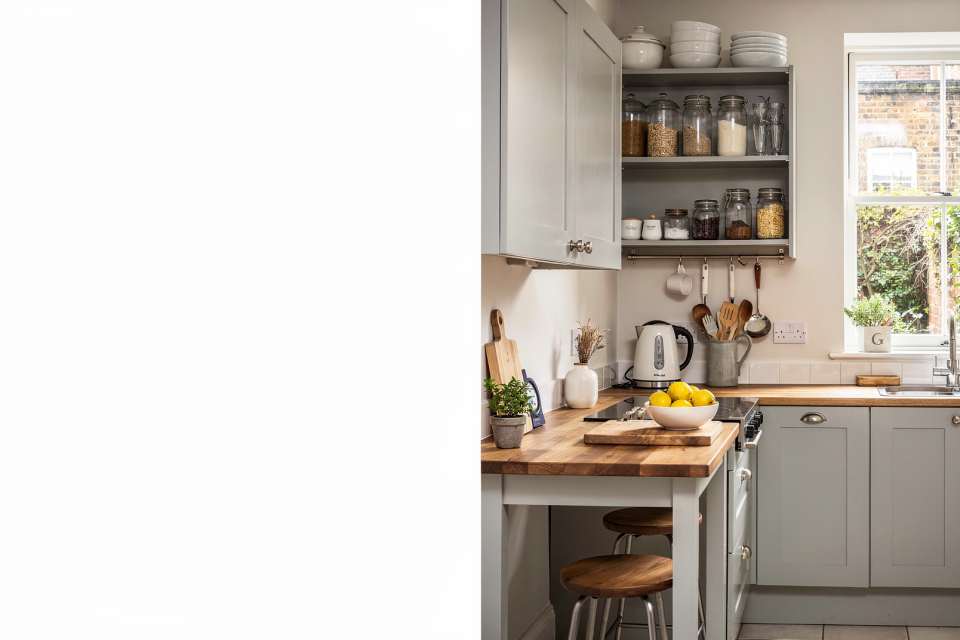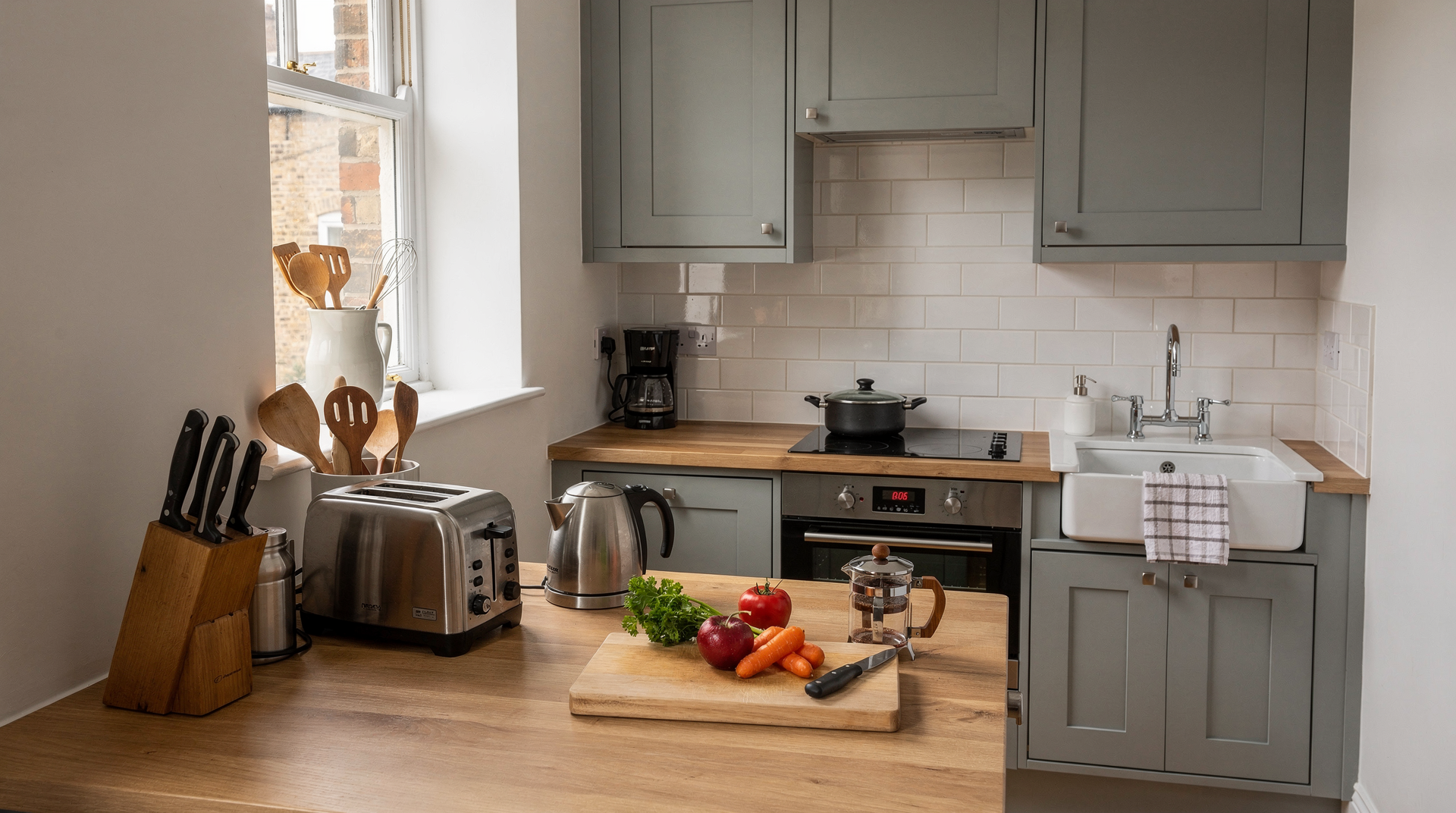
A compact British kitchen works best when every tool earns its place. The goal is not to own less for the sake of it, but to build a set of reliable essentials that helps you cook faster, waste less, and stay calm when the worktop is small and the week is busy.
This guide walks through the stages of building a small-kitchen toolkit: what to buy first, what becomes useful as your cooking expands, and which items are optional rather than essential. The focus is practical, UK-specific, and realistic for flats, terraced houses, shared homes, and kitchens that have to work hard every day.
Start with the reality of a compact kitchen
A small kitchen usually fails for one of three reasons:
- too many duplicate tools
- poor storage choices
- buying equipment for rare tasks instead of everyday cooking
In a compact space, the best tools do more than one job. A saucepan that heats evenly, a sharp chef’s knife, and a sturdy baking tray will often matter more than a drawer full of gadgets. I’ve seen too many kitchens where a spiraliser takes up precious drawer space while the one decent saucepan is buried behind novelty mugs and mismatched lids.
Before buying anything, look at how you cook now:
- Do you mostly make weeknight dinners?
- Are you batch cooking for work lunches?
- Do you bake occasionally, or never?
- Do you have an oven, hob, microwave, or air fryer?
- Is cupboard space tight, or is counter space the real issue?
Your answers determine which tools deserve priority. If you’re in a rented flat with two cupboards and a single drawer, your choices will look different from someone with a galley kitchen and reasonable storage. Be honest about what you actually cook, not what you’d like to think you cook. That Marks & Spencer recipe you clipped three months ago doesn’t count if you’ve made spaghetti Bolognese four times since then.
Stage 1: The core essentials every small British kitchen needs
If you are setting up from scratch, begin here. These are the tools that support most everyday meals without taking over your cupboards. I’ve refined this list over years of cooking in everything from a Toronto house with generous counters to a London flat where the kitchen is basically a corridor.
| Tool | Why it matters | Best small-kitchen version |
|---|---|---|
| Chef’s knife | Handles chopping, slicing, and general prep | One comfortable, well-balanced 20 cm knife |
| Paring knife | Useful for peeling and smaller jobs | Small, sharp, easy to store |
| Chopping board | Protects surfaces and makes prep safer | Medium board that is stable and easy to wash |
| Large saucepan | For pasta, soups, rice, veg, and sauces | 2–3 litre pan with a lid |
| Frying pan or skillet | For eggs, fish, chicken, vegetables, and quick sauces | 24 cm non-stick or stainless-steel pan |
| Baking tray | Roasting veg, chips, sausages, and traybakes | Heavy-duty tray that fits your oven well |
| Mixing bowl | For batters, marinades, salads, and leftovers | One medium and one large nesting bowl |
| Measuring jug | Helpful for sauces, gravy, and baking | Clear, easy-read jug |
| Wooden spoon or silicone spatula | Stirring, scraping, and mixing | Heat-safe, one or two only |
| Colander or sieve | Draining pasta and washing produce | Collapsible if storage is very tight |
These items cover most British home cooking, from jacket potatoes and traybakes to curries, soups, stir-fries, and Sunday-style roasting. I’ve made entire weeknight dinners with nothing more than a saucepan, baking tray, and a decent knife. The trick is knowing your tools well enough that they become extensions of your hands rather than obstacles.
What to buy first if budget is tight
If you can only buy a few things, prioritise in this order:
- A good chef’s knife
- One solid saucepan
- One reliable frying pan
- A chopping board
- A baking tray
- A mixing bowl
- A colander
That order reflects frequency of use, not glamour. A cheap extra gadget is less valuable than one pan that distributes heat properly and lasts. I’d rather have a single decent saucepan from Tesco’s home range that heats evenly than three warped ones from a discount bin. When I moved to London, I started with exactly this list and cooked perfectly good meals for months before adding anything else.
Stage 2: Tools that make everyday cooking easier
Once the basics are in place, the next layer is about comfort and speed. These are not luxuries; they solve common frustrations in a small kitchen. After a long day when you’re staring at a bag of carrots and some chicken thighs, the right tool can mean the difference between a proper dinner and toast.
Useful upgrades
- Kitchen scales
Essential for baking and helpful for portioning rice, pasta, and ingredients for meal prep. In the UK, many home cooks still rely on weight-based recipes, so scales are more practical than guesswork. Most British recipes list ingredients in grams, and converting on the fly while your onions catch is nobody’s idea of fun. - Vegetable peeler
Saves time on carrots, potatoes, and apples, and is often easier than a knife for quick prep. A Y-shaped peeler from Sainsbury’s or Lidl works brilliantly and takes up almost no space. - Tongs
Useful for turning sausages, lifting roasted veg, and handling hot food without cluttering the pan. Get one decent pair rather than three cheap ones that slip. - Can opener
A simple but frequently overlooked tool if you use tinned tomatoes, beans, tuna, or sweetcorn. Nothing derails dinner faster than discovering your opener broke mid-recipe. - Box grater
Good for cheese, onions, carrots, and zest. A flat, sturdy grater usually stores better than a bulky multi-sided one. I keep mine in a drawer rather than standing on the counter, which saves precious worktop space. - Microfibre cloths and washing-up brush
In a compact kitchen, cleaning tools matter because mess spreads faster when space is limited. A clean surface is your main prep area, your dining table, and your workspace all in one. - Food storage containers
Choose stackable containers with secure lids so leftovers and batch-cooked portions do not take over the fridge. The ones from IKEA or Lakeland nest beautifully and don’t cost the earth.
Why this stage matters
This is usually the point where people notice the difference between “having kitchen stuff” and “having a kitchen that works”. A few well-chosen tools reduce frustration, cut prep time, and make it easier to cook at home after a long day. When you can grab tongs without rummaging through a cluttered drawer, you’re more likely to cook rather than reach for the takeaway menu.
Stage 3: Storage and organisation become as important as tools
In a compact kitchen, organisation is part of the equipment list. Even excellent tools become a problem if they are hard to reach. I learned this the hard way after spending ten minutes hunting for a whisk buried behind a bread maker I used twice in three years.
Storage principles for small British kitchens
- Keep daily-use items between waist and eye level.
- Store rarely used appliances higher up or out of the main prep zone.
- Nest bowls, pans, and containers where possible.
- Use vertical space with hooks, rails, or shelf risers.
- Avoid owning multiples unless you genuinely need them.
A simple zone-based approach
| Zone | What belongs there | Why |
|---|---|---|
| Most accessible drawer or shelf | Knife, spoon, spatula, peeler, scissors | Items you use daily |
| Near the hob | Saucepan, frying pan, ladle, tongs | Faster cooking and less moving around |
| Near the prep area | Board, knife, bowl, grater | Smoother chopping and mixing |
| Higher shelf or cupboard | Baking tins, spare containers, special utensils | Less frequent use |
This kind of setup matters even more in rented UK kitchens, where you may not be able to change fixtures or add permanent storage. I’ve used tension rods under sinks for spray bottles and adhesive hooks inside cupboard doors for measuring spoons. When you can’t drill into walls, you get creative.
Stage 4: Add specialist tools only when your cooking justifies them
At this stage, you are no longer buying “essentials”. You are choosing tools that match the way you actually cook. This is where honesty matters most. I once bought a pasta maker because I imagined leisurely Sunday afternoons rolling fettuccine. The reality was Tuesday nights with a jar of pesto and dried spaghetti.
Helpful, but not universal
- Slow cooker
Good for stews, curries, pulled meats, and low-energy batch cooking. Useful if you want dinner ready after work. A slow cooker earns its keep in winter when you crave something warm after a wet commute home. - Air fryer
Helpful for smaller portions, crisping vegetables, reheating leftovers, and reducing oven use. Worth it if you cook frequently and have counter space. For single portions or couples, an air fryer can replace the oven for most weeknight meals and use less electricity. - Hand blender
Excellent for soups, sauces, and smoothies. More compact than a jug blender. I use mine weekly for blitzing soup directly in the saucepan, which saves washing up an extra appliance. - Stand mixer
Valuable for frequent baking, but often unnecessary in a cramped kitchen unless baking is a real habit. If you make bread weekly, it might justify the space. If you bake Victoria sponge twice a year, a hand whisk does fine. - Digital thermometer
Useful for meats, bread, and confidence with temperature-sensitive cooking. A probe thermometer takes up less space than a cookbook and prevents dry chicken. - Kitchen timer
Many phones do the job, but a dedicated timer can be easier when cooking several things at once. I keep a simple magnetic one on the fridge so I don’t have to wash floury hands before touching my phone.
How to decide if a specialist tool is worth it
Ask three questions:
- Will I use this at least once a week?
- Can another tool already do the job well enough?
- Where will I store it without causing clutter?
If the answer to the first two questions is “no”, it is probably not an essential purchase. I apply this test every time I’m tempted by the middle aisle at Lidl.
Stage 5: Match tools to your cooking style
The best small-kitchen setup depends on how you live, not just what recipes you like. Your toolkit should reflect your actual Tuesday evening, not your aspirational Sunday afternoon.
If you cook mostly quick weeknight meals
Focus on:
- knife
- chopping board
- saucepan
- frying pan
- tongs
- spatula
- storage containers
This set suits pasta dinners, omelettes, stir-fries, soup, fish, and one-pan meals. When you’re home at six and hungry by seven, this is all you need.
If you batch cook for the week
Add:
- large saucepan
- baking tray
- airtight containers
- kitchen scales
- colander
- ladle
- hand blender
This makes it easier to prep soups, stews, rice dishes, roast vegetables, and portioned lunches. Sunday afternoon with the radio on, filling containers for the week ahead, is one of my favourite kitchen rituals.
If you bake occasionally
Add:
- scales
- mixing bowls
- measuring jug
- baking tray
- cake tin or loaf tin
- sieve
Do not buy a full baking arsenal if you only make a traybake every few months. A single loaf tin and a baking tray will handle most occasional baking needs without filling your cupboards.
If you share a kitchen
Prioritise:
- clearly labelled storage
- stackable containers
- one good knife you keep separate
- durable pans that do not disappear into someone else’s cupboard
- easy-clean tools that can handle frequent use
Shared kitchens need simplicity, not excess. I’ve lived in enough shared houses to know that your best pan will walk off unless you keep it somewhere obvious and labelled.
Common mistakes in compact kitchens
Buying too many “maybe useful” items
A garlic press, avocado slicer, egg separator, and spiraliser may all work well once in a while, but most small kitchens are better served by broad-use tools. That garlic press you bought two years ago has probably been used twice, while your chef’s knife handles garlic perfectly well every day.
Choosing tools that are hard to store
Bulky utensils, oversized pans, and awkward novelty gadgets create friction every time you cook. If you have to move three things to reach your saucepan, you’ll cook less often.
Ignoring quality in high-use items
For a small kitchen, the most-used tools matter more than almost anything else. A poor knife or warped pan becomes annoying very quickly. Spend where it counts and save on the rest.
Overfilling drawers and cupboards
If you cannot reach what you need without shifting several items, the kitchen is already too crowded. When every drawer requires a game of Tetris to open, it’s time to edit.
Buying for ideal cooking instead of real life
A kitchen set should reflect your actual routine on a busy Tuesday, not the meals you imagine making when you have plenty of time. Be honest about whether you’re a midweek pasta person or a weekend baker, and stock accordingly.
Quick checklist: the compact kitchen essentials audit
Use this checklist to see what you already have and what still needs attention.
- One sharp chef’s knife
- One small paring knife
- One stable chopping board
- One large saucepan with lid
- One frying pan
- One baking tray
- One mixing bowl
- One colander or sieve
- One measuring jug
- Kitchen scales
- Vegetable peeler
- Tongs
- Wooden spoon or silicone spatula
- Storage containers
- Can opener
- Cleaning cloths and washing-up brush
If you have most of these, you do not need to keep “setting up” your kitchen. You may only need better organisation or one carefully chosen upgrade. Sometimes the best kitchen improvement is simply rearranging what you already own.
How to keep a small kitchen working well over time
A compact kitchen is easiest to live with when you review it regularly. I do a quick audit every few months, usually when I notice I’m getting annoyed with a drawer that won’t close or a pan that’s lost its non-stick surface.
Every few months, check:
- which tools you have not used
- which items have become duplicated
- whether your pans still heat evenly
- whether your containers still have lids that fit
- whether anything is stored in the wrong place
A simple rule for new purchases
Before buying a new kitchen tool, remove one old item or make a clear storage plan. This keeps the kitchen from slowly filling with clutter that seems harmless at first. I follow a one-in-one-out rule for anything larger than a wooden spoon, and it’s saved my cupboards from chaos.
FAQ
What are the absolute must-have tools for a small kitchen?
The essentials are a chef’s knife, chopping board, saucepan, frying pan, baking tray, mixing bowl, and colander. These cover most everyday cooking without wasting space. Start here and add only what you genuinely need.
Is a kitchen gadget ever worth it in a compact kitchen?
Yes, but only if it solves a real problem you face often. A hand blender, air fryer, or slow cooker can be worth the space if you use it regularly. The key is honesty about how often you’ll actually use it, not how often you imagine you might.
Should I buy a full knife set?
Usually no. One good chef’s knife and one small paring knife are enough for most home cooks. Knife blocks often take more space than they justify and include knives you’ll rarely touch. Invest in one decent knife and learn to use it well.
What is the best first upgrade after the basics?
For many people, it is either kitchen scales or a better frying pan. Both make daily cooking easier and improve results quickly. Scales are particularly useful for British recipes that rely on weight measurements.
How do I stop my small kitchen from getting cluttered?
Avoid duplicates, store items by frequency of use, and buy only tools that fit the way you actually cook. If something is awkward to reach or rarely used, it probably should not stay in the main kitchen area. Regular audits and a one-in-one-out rule prevent slow accumulation.
Final thoughts
A compact British kitchen does not need to be packed with equipment to be useful. It needs a small set of reliable tools, stored sensibly, chosen for the meals you cook most often, and upgraded only when your cooking routine truly changes.
Start with the essentials, add only what solves a real problem, and let the kitchen grow around your actual habits rather than an idealised version of them. The best kitchen isn’t the one with the most tools. It’s the one where you can find what you need, cook what you want, and actually enjoy the process, even on a rainy Tuesday when the worktop is small and the week is busy.